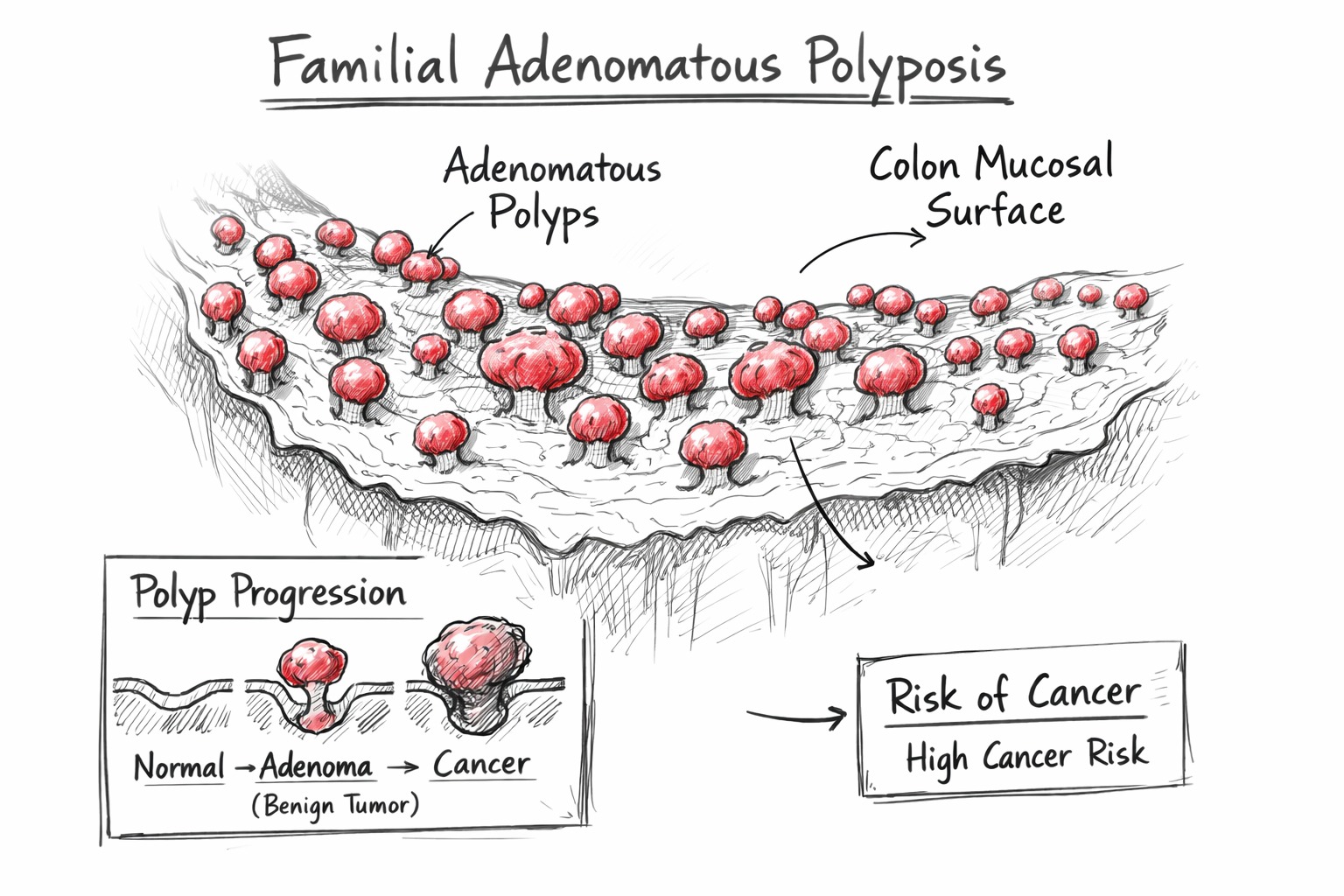
Familal Colorectal Cancer
A 20-Year-Old Who Should Not Have Had Cancer
A young boy walked into my OPD with bleeding in stools and weight loss. He was only 20. On deeper questioning, a pattern emerged — multiple family members had died of cancer, most of them had colorectal cancer. Today, only two members remain alive in that family: the patient and one elderly grandparent.
Genetic Fate or Preventable Future?
Born with genes. Protected by awareness.
Genes do not forget, they penetrate silently through generations. We may be born with a risk we did not choose. But with awareness, we can prevent what they predict.
This is not theory. This is real life.
A 20-Year-Old Who Should Not Have Had Cancer
A young boy walked into my OPD with bleeding in stools and weight loss. He was only 20. On deeper questioning, a pattern emerged — multiple family members had died of cancer, most of them had colorectal cancer. Today, only two members remain alive in that family: the patient and one elderly grandparent.
His CT scan and colonoscopy revealed the feared diagnosis — colon cancer with multiple polyps throughout the colon.
This was not just a cancer. This was a genetic warning.
He was diagnosed with a hereditary colorectal cancer syndrome. We performed a major surgery — removing not only the cancer but the entire colon, which was genetically prone to developing further cancers.
He recovered well.
Eight years later, he continues to do well, living a productive life. During follow-up, he developed some benign lesions — known to occur in such genetic conditions — for which he required a smaller procedure.
Because we identified the syndrome early, we could act decisively.
When Partial Treatment Is Not Enough
In another case of familial colorectal cancer, only the cancerous segment was removed elsewhere. The underlying genetic condition was not addressed. She later presented to us with a second cancer in the remaining colon.
This time, we had to perform a more complex surgery — removing the entire remaining colon in a previously operated abdomen.
Genetic diseases do not stop at just surgery. They require foresight.
What Is Familial Colorectal Cancer?
Certain inherited syndromes — such as Lynch syndrome and Familial Adenomatous Polyposis — make individuals prone to developing colorectal cancer and other associated cancers at a younger age.
These conditions are identifiable.
And if identified early, cancers can be prevented.
Who Should Be Evaluated?
You should suspect a genetic colorectal cancer syndrome if:
-
Cancer occurs before 50 years of age
-
Two or more family members have cancer
-
Multiple polyps are found in the colon
-
There is a pattern of colorectal and endometrial or related cancers in the family
These are not coincidences.
They are genetic signals.
Why Early Identification Matters
If detected in time:
✔ High-risk family members can undergo screening
✔ Preventive surgery may be offered when necessary
✔ Cancers can be avoided — not just treated
✔ Families can live normal, long lives
Genetics may load the gun. Awareness prevents it from firing.
Final Message
Do not ignore:
-
Bleeding in stool
-
Unexplained weight loss
-
Strong family history of cancer
Cancer in young individuals is not “bad luck” — it is often biology asking to be investigated.
Be aware. Be cautious. Get screened. Prevent disaster.